Dwelling
Peter's offer to build a few tents on a mountain

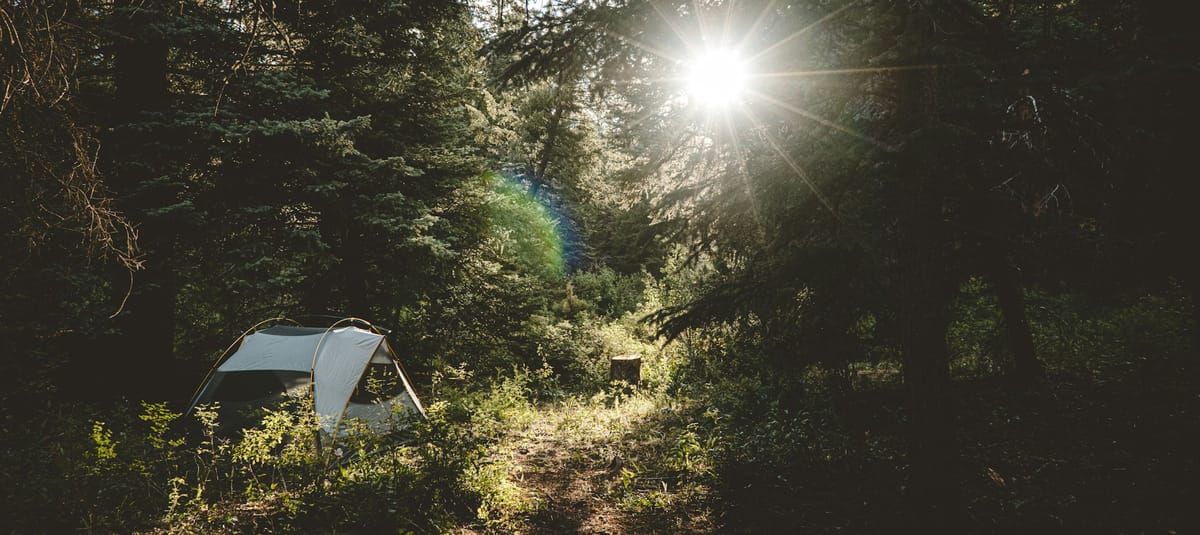
It's Transfiguration Sunday (if you're using the revised common lectionary...). I am building my excitement for Lent as it is my favourite season. Today when I looked at the readings it was a footnote that caught me. Matthew 17.4, "Then Peter said to Jesus, ‘Lord, it is good for us to be here; if you wish, I will make three dwellings [Or tents] here, one for you, one for Moses, and one for Elijah.’"
Tents are significant throughout the Bible. Our Exodus reading comes from a time that Israel was a nomadic people, traveling between Egypt and the promised land. Although they dwell in certain places for extended time they are in tents. When we see the Ark of the Covenant it resides in a tent until the temple was built; which when David wanted to build it God says, 2 Samuel 7.6-7 "I have not lived in a house since the day I brought up the people of Israel from Egypt to this day, but I have been moving about in a tent and a tabernacle. Wherever I have moved about among all the people of Israel, did I ever speak a word with any of the tribal leaders of Israel, whom I commanded to shepherd my people Israel, saying, ‘Why have you not built me a house of cedar?’"
Tents show a temporary nature; once the temple was built its perceived permanence becomes more the grandeur of humans then God (for God does not need temples). I reflect also on the Aboriginal Tent Embassy in the Parliamentary Triangle here in Canberra; in the acknowledgement of the temporary nature we don't want a building, one day we would want the tents to come down for all the right reasons (if this ever happens what a glorious day it will be; though I believe creation will pass away first). Much the same could be said for tent villages of homeless, and refugees, we hope they come to the end for the right reasons.
Yet, Peter desires to build tents for Jesus, Moses and Elijah. It is an act of service to two great prophets and the Messiah; serving the importance of their meeting, surely it should be longer than the time without shelters. The temporary nature comes crashing through with the Father speaking from a bright cloud and the moment approaching its end. The Son of Man doesn't need a tent to dwell in and rest his head, nor does any person of God need a dwelling place; all of Creation couldn't bear to hold God for an instant.
No matter how grandeur we build a place we need to know the temporal nature that creation is in. Church architecture is very important for people and the experience of people; spires reach above the local houses allowing people to see the church, bell towers lift the sound above the surrounding buildings, tall internal roofs can lift up eye-lines in the church, spaces can be made for more then just a Sunday congregation giving support to the community around them, artworks like stain glass give the witness time to pause. Yet the buildings pass away, they are tents. They can't hold the God within and if they did the church itself would be a failed institution; they are all temporary, a means to the end; they are a tent, established temporally. There can be sadness when they are removed and the time passes but one day they will be removed as they are needed no more.
As we celebrate the fleeting moment of the Transfiguration before the Crucifixion we also remember the fleeting moments of the world; that God's choice to dwell in human form blends the impossibility of the infinite with the finite.